
Etna North or Etna South? This is one of the most common questions asked by travellers planning to explore Sicily's most famous volcano. Both sides belong to the same mountain, yet they offer different landscapes, atmospheres and sightseeing opportunities.
On one side is Etna South, famous for Rifugio Sapienza, the Silvestri Craters and vast volcanic landscapes. On the other is Etna North, home to Piano Provenzana, the forests around Linguaglossa, ancient lava flows and a distinctive mountain environment.
Choosing the right side means planning your day more effectively, avoiding unnecessary journeys and spending more time discovering the places that genuinely interest you.
In this guide, we explore the differences between Etna North and Etna South, what to see on each side, the experiences available and how to choose according to the season, your departure location and your preferred style of travel.
For a complete introduction to the volcano, read our guide: Mount Etna: What to See among Craters, Volcanic Landscapes and Villages.
Etna North and Etna South: what are the differences?
Mount Etna covers an extensive area, with slopes characterised by different vegetation, elevations, landscapes and road connections.
The distinction between Etna North and Etna South mainly concerns the principal visitor access areas and the types of environment encountered.
Etna South: open landscapes and recognisable volcanic craters
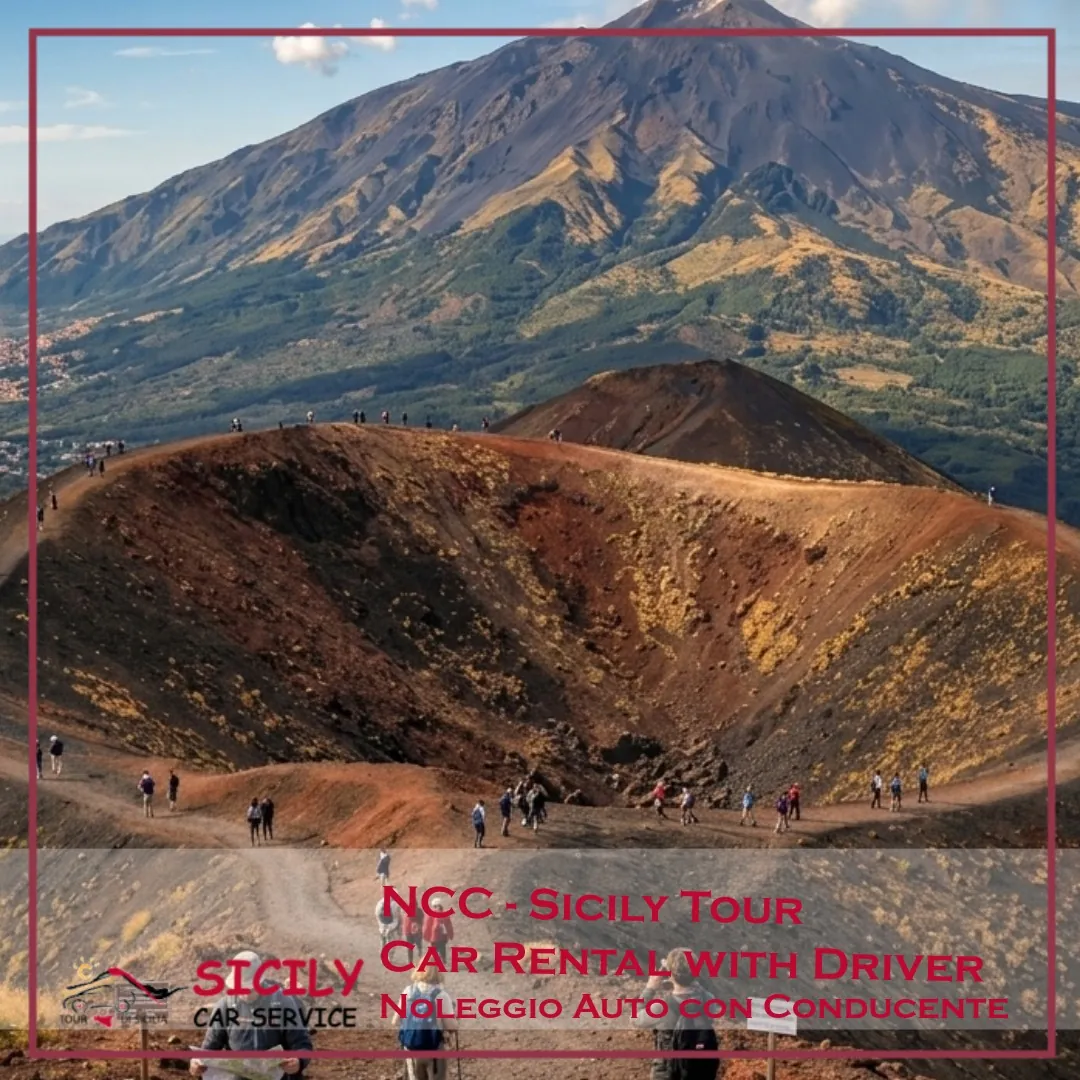
The southern slope is particularly well known for Rifugio Sapienza and the Silvestri Craters, located at approximately 1,900 metres above sea level.
The landscape is dominated by volcanic sand, lateral cones, lava flows and sweeping views across eastern Sicily.
It is especially interesting for first-time visitors who want to observe some of Mount Etna's most distinctive volcanic formations without necessarily undertaking a long hike.
Etna North: forests, lava and mountain scenery
The northern slope is known for Piano Provenzana, accessible through the Linguaglossa area.
Here, the scenery offers a striking contrast between woodland, mountain trails, ancient lava flows and wide volcanic surfaces.
Etna North is particularly attractive to travellers who enjoy nature, less developed mountain landscapes and the contrast between vegetation and volcanic rock.
Etna South: what to see
The southern slope includes some of Mount Etna's best-known visitor attractions. This area offers numerous opportunities to observe evidence of volcanic activity at relatively accessible locations.
Rifugio Sapienza
Rifugio Sapienza is one of the main reference points for visitors exploring Etna South.
Located at approximately 1,900 metres above sea level, it is surrounded by volcanic scenery and serves as a starting point for different tourist activities.
On clear days, the area offers impressive views towards Sicily's eastern coastline and reveals contrasts between relatively recent lava surfaces and older terrain gradually colonised by vegetation.
The Silvestri Craters
The Silvestri Craters are among the most representative attractions on Etna South.
They formed during the eruption of 1892 and remain an important example of the volcano's lateral eruptive activity.
The ground features black volcanic sand, lava rocks and reddish tones. Observing the craters provides a useful introduction to how volcanic cones form and how landscapes evolve over time.
Visitors should stay on permitted routes and take care when walking over uneven volcanic terrain.
Lava landscapes on Etna South
One of the most fascinating features of the southern slope is its extensive lava fields.
These flows record eruptions from different periods and display a variety of shapes, colours and textures.
Some areas appear almost completely without vegetation, while others have gradually been colonised by mosses, lichens and plants.
For photography enthusiasts, these contrasts create particularly memorable landscapes.
Excursions to higher elevations
Organised activities towards higher elevations may operate from the southern slope, depending on weather conditions, volcanic activity and restrictions issued by the relevant authorities.
High-altitude excursions are different from visits to the main tourist areas and may require qualified mountain or volcano guides.
Always check access conditions before departure, and never assume that reaching a particular elevation is guaranteed.
Etna North: what to see
Etna North offers a different landscape. Its mountain character is particularly noticeable, with forests, volcanic areas and scenery that changes progressively as the altitude increases.
Piano Provenzana
Piano Provenzana is one of the main visitor areas on the northern slope of Mount Etna.
It is located at approximately 1,800 metres above sea level and can be reached through the Linguaglossa area.
The area is an important starting point for discovering the volcanic environment of Etna North and observing the contrast between ancient lava surfaces and mountain vegetation.
Evidence of the 2002 eruption
The eruption of 2002 had a major impact on Mount Etna's northern slope.
Evidence of the event remains visible in parts of the region, where the eruption transformed roads, facilities and the surrounding landscape.
These traces help visitors understand how volcanic activity can dramatically reshape a mountain environment within a relatively short period.
The forests of Linguaglossa
One of the most appealing characteristics of Etna North is its extensive woodland.
Around Linguaglossa and along the roads climbing towards Piano Provenzana, the landscape includes trees, mountain vegetation and ancient lava flows.
The contrast between green forests and dark volcanic rock is one of the most distinctive features of this side of the mountain.
Panoramic views and nature trails
The northern slope offers interesting opportunities to admire mountain scenery and explore nature trails in areas where access is permitted.
Some routes require physical preparation, appropriate footwear and awareness of mountain conditions.
Before starting a trail, always check its difficulty, distance, weather conditions and any restrictions.
Etna North vs Etna South: comparison of the two slopes
Comparing their main characteristics can help you decide which side is most suitable for your visit.
| Feature | Etna South | Etna North |
|---|---|---|
| Main visitor area | Rifugio Sapienza | Piano Provenzana |
| Typical landscape | Craters, volcanic sand and extensive lava fields | Forests, lava flows and mountain scenery |
| Landmark | Silvestri Craters | Piano Provenzana |
| Recommended experience | First visits and observation of lateral craters | Nature, forests and volcanic landscapes |
| Nearby villages | Nicolosi, Zafferana Etnea and other eastern slope towns | Linguaglossa, Randazzo and other northern slope towns |
| High-altitude excursions | Subject to availability and safety conditions | Subject to availability and safety conditions |
This comparison is intended as a general guide. Both sides offer a range of landscapes and activities that can vary according to the season and volcanic conditions.
Which side of Mount Etna is best for first-time visitors?
For travellers who have never visited the volcano, Etna South can be particularly interesting thanks to the Silvestri Craters and the opportunity to observe a recognisable volcanic landscape.
Etna North, on the other hand, may appeal more to visitors who want to spend time exploring forests, mountain nature and the contrast between vegetation and lava flows.
In both cases, it is advisable not to overload the itinerary. Choose a programme that reflects your interests and allows enough time to enjoy the scenery.
Etna North or Etna South with children?
Visiting Mount Etna with children is possible, provided activities are suitable for their age, abilities and the conditions on the day.
The southern slope can be interesting for observing lateral craters near Rifugio Sapienza, choosing routes appropriate for children.
The northern slope can offer nature experiences among woodland and volcanic landscapes.
When deciding, consider:
- the children's ages;
- journey times;
- weather conditions;
- trail difficulty;
- wind and low temperatures;
- the need for regular breaks;
- the availability of family-friendly activities.
A long or demanding hike is not necessary for children to appreciate the fascinating landscape of Mount Etna.
Etna North or Etna South in winter?
During winter, both slopes can offer beautiful snow-covered scenery.
However, snow, ice and strong winds can affect road accessibility and walking conditions.
Your choice should therefore be based on the latest weather information, road conditions and availability of visitor services.
Avoid planning a rigid itinerary without allowing for possible closures or last-minute changes.
Etna North or Etna South in summer?
During summer, generally longer daylight hours provide greater flexibility for panoramic visits.
Nevertheless, higher elevations can be windy, and exposed volcanic areas can experience intense sunshine.
For both slopes, it is advisable to bring:
- shoes suitable for uneven terrain;
- layered clothing;
- a windproof jacket;
- drinking water;
- sun protection;
- appropriate awareness of weather conditions.
Even in midsummer, the climate on Mount Etna can be very different from conditions along the Sicilian coast.
From Taormina, is Etna North or Etna South better?
Travellers staying in Taormina can consider both slopes.
Etna North is generally reached through the Linguaglossa area, while Etna South uses different road connections towards the southern side of the volcano.
The decision should not be based solely on distance, but also on the attractions you want to visit.
An itinerary towards Etna North can be combined with Linguaglossa or Randazzo.
A journey towards Etna South can be combined with Zafferana Etnea or other towns in the surrounding region.
To explore more excursion possibilities from your holiday destination, read: Tours from Taormina: the Best Private Excursions Without Stress.
Villages to visit near Etna North
Exploring the northern slope is also an opportunity to discover interesting historic towns.
Linguaglossa
Linguaglossa preserves a historic centre rich in architectural features and has a strong connection with life on Mount Etna's northern slope.
It is an appealing destination for a walk after exploring the mountain.
Randazzo
Randazzo is known for its medieval historic centre and the widespread use of volcanic stone in its buildings.
Its churches and historic streets allow visitors to add a cultural experience to a day dedicated to the volcano.
Villages to visit near Etna South
The southern and eastern sides of Mount Etna also offer interesting towns that can be combined with a volcano visit.
Nicolosi
Nicolosi is one of the towns historically associated with access to Mount Etna's southern slope.
It provides an opportunity to learn more about the relationship between local communities and the mountain.
Zafferana Etnea
Zafferana Etnea is known for its traditional products, honey-making heritage and position on the eastern slope of the volcano.
It is a pleasant destination for a food stop or a leisurely walk.
Can you visit Etna North and Etna South in one day?
It is possible to travel between the two slopes, but doing so is not always worthwhile during a single-day visit.
Roads do not cross directly over the volcano's summit. Travelling from one side to the other requires routes around the mountain.
This adds journey time and can reduce the opportunity for walks, photo stops and village visits.
For a first experience, concentrating on one slope is generally the more enjoyable option.
If you have several days available, visiting Etna North and Etna South separately allows you to appreciate their different landscapes more fully.
Suggested itinerary for Etna South
A possible day programme could include:
- departure from Taormina or Catania;
- arrival in the Rifugio Sapienza area;
- visit to the Silvestri Craters, when permitted;
- observation of volcanic landscapes;
- panoramic stops;
- descent towards Zafferana Etnea or Nicolosi, depending on the chosen route;
- a local food break;
- return to your accommodation.
The programme should be adapted to the season, road conditions and weather.
Suggested itinerary for Etna North
An itinerary on the northern slope could include:
- departure from Taormina or another location in eastern Sicily;
- journey through Linguaglossa;
- arrival in the Piano Provenzana area;
- visits to accessible panoramic viewpoints;
- observation of ancient lava flows;
- return towards Linguaglossa;
- an optional visit to Randazzo, if time allows;
- return to your holiday accommodation.
The day should be planned without too many stops, leaving enough time to appreciate the landscape.
Visiting Mount Etna with a private chauffeur
Choosing between Etna North and Etna South can become easier when transport is organised in advance.
A private chauffeur service allows travellers to reach road-accessible destinations without worrying about driving, parking or managing transfers.
Sicily Car Service, based in Taormina, organises private itineraries and transfers across eastern Sicily, including the villages and visitor areas surrounding Mount Etna.
The programme can be personalised according to the chosen slope, departure point, season and travellers' interests.
High-altitude excursions and specialist activities must be organised separately in accordance with current regulations and with qualified guides where required.
Conclusion: is Etna North or Etna South better?
Choosing between Etna North and Etna South mainly depends on the experience you would like.
The southern slope is particularly attractive to visitors who want to discover the Silvestri Craters, enjoy extensive lava landscapes and observe some of Mount Etna's most distinctive volcanic formations.
The northern slope is ideal for travellers who appreciate woodland, mountain nature, volcanic scenery and historic villages.
Both reveal important aspects of Mount Etna and demonstrate just how varied and fascinating the volcano can be.
For a broader introduction to the main attractions, read: Mount Etna: What to See among Craters, Volcanic Landscapes and Villages.
Contact Sicily Car Service
Sicily Car Service
Via Arancio n. 29, Taormina (ME), Sicily, Italy
Phone: +39 333 160 6317 – +39 328 481 7474
Email: info@sicilycarservice.com
Office hours: Monday–Friday, 08:00–20:00, with 24/7 standby service.
Would you like to organise a visit to Etna North or Etna South? Tell us your departure location, travel dates, number of passengers and preferred experience. We can help you arrange a private itinerary with panoramic stops, realistic timings and comfortable transfers.
FAQ – Etna North or Etna South
Is Etna North or Etna South better?
It depends on your preferences. Etna South is particularly interesting for the Silvestri Craters, Rifugio Sapienza and open lava landscapes. Etna North offers forests, mountain scenery, Piano Provenzana and ancient lava flows.
What is the main difference between Etna North and Etna South?
The main difference concerns their landscapes and visitor access areas. Etna South is known for lateral craters and open views, while Etna North is known for woodland, Piano Provenzana and contrasts between vegetation and lava.
Which side of Mount Etna is best for first-time visitors?
Etna South can be an excellent option for a first visit thanks to the Silvestri Craters and Rifugio Sapienza. Etna North is a good alternative for travellers who prefer mountain scenery and natural environments.
Can you visit Etna North and Etna South on the same day?
Travelling between the two slopes is possible, but it takes time because roads follow routes around the mountain. For a more relaxed visit, it is generally better to focus on one side.
Where are the Silvestri Craters?
The Silvestri Craters are located on the southern slope of Mount Etna, near Rifugio Sapienza, at approximately 1,900 metres above sea level.
Where is Piano Provenzana?
Piano Provenzana is on Mount Etna's northern slope, at approximately 1,800 metres above sea level, and can be reached through the Linguaglossa area.
Which side is better for visiting Mount Etna with children?
Both can offer family-friendly experiences if you select simple routes suitable for the children's ages. Always consider altitude, temperatures, terrain and access conditions.
Which side is more convenient from Taormina?
Both slopes can be reached from Taormina. The most suitable choice depends on the attractions you want to visit, road routes and the time available.
Do you need a guide for Etna North or Etna South?
Not every tourist area requires a guide. High-altitude routes or regulated areas may require qualified guides and may be subject to access restrictions.
Can you organise a private tour of Mount Etna?
Yes. A private itinerary with a chauffeur-driven vehicle can be arranged to road-accessible destinations, choosing the slope and stops according to your requirements.